

Course Description:
It is not uncommon for many of today’s higher tech maintenance training to involve the use of both shop math and precision measurement. Too often, the last math or measurement course attended by the multi-craftsman was back in high school or trade school—a long time ago. This course is a comprehensive review of the basics of shop math and use of precision measurement instruments with a hands-on approach. The course provides the multi-craftsman with the math/measurement tools needed to attend advanced maintenance seminars in topics like reading a pump curve, calculating pressure head, collinear shaft alignment, dynamic balancing, and circuit voltage and amperage calculations and well as how to used precision measurement tools for bearing fits, thread engagement, dial indication TIR check and the use of a taper gauge for coupling alignment. This course guarantees much better success for the craftsman who must tackle future calculations or measurements involved in today’s world of more complicated technology. The attendee will leave the course with an very comprehensive review of shop math and precision maintenance measurement skills learned by doing using hands-on techniques.
Each student will receive class books, work activity sheets, self-test progress evaluations, as well as questions from the instructor to make sure they understand the material presented. It is expected that an attendee will leave the class with the basic knowledge of the subject and possess new-found skills to better equip them when they return to their job. A certificate suitable for framing will be issued to each attendee who successfully completes the course.
Hands-on activities:
80% hands-on activities
Free Materials included:
Scientific Calculator ($11 value)
0-1” Metric/Imperial Scale ($11)
0-1” Vernier Micrometer ($55)
2-day course: $1095 per person
Course Syllabus
SHOP MATHEMATICS
-
Use of a calculator
-
The function keys
-
Recalling a number
-
Storing in memory
-
-
Working with Whole Numbers
-
Working with Simple Fractions
-
Working with Complex Fractions
-
Working with Decimals
-
Common decimal equivalencies
-
Rounding off
-
-
Working with Percentages
-
Sales taxes
-
Increasing or decreasing
-
-
Working with Measurements
-
Working with Exponents
-
Motor magnetics
-
Bearing life
-
-
Working with Ratios and Proportions
-
Sheave and belt calculation
-
Gear calculation
-
Cross multiplication
-
Scaling a drawing
-
-
Plane Figures
-
Working with Plane and Solid Figures
-
Pythagoras theorem
-
3-4-5 triangle
-
Volume in a pipe or tank
-
-
Working with Graphs and Curves
-
Construction of Data Tables
PRECISION MEASUREMENT
-
Early measurement tools—foot, cubit, yard, span, hand
-
Standardized measurement—Eli Whitney—a revolutionary in the world of measurement
-
English system of measurement vs. Metric system
-
Using a ruler-rules for measuring length, width and height
-
Graduations in rulers
-
Measuring circumferences of pipes, tanks and other cylinders
-
Direct and indirect measurement–calculation of dimensions
-
Using calipers-inside, outside, and transferring measurements
-
Measuring fasteners: nuts, bolts, and screws—the pitch gauge
-
Standards for fasteners—NC (National Course), NF (National Fine), SAE, NPT (Pipe Threads)—Metric Threads
-
Determining the strength of fasteners—torque measurement
-
Vernier caliper-0.001” accuracy
-
Outside micrometer—0.001 and 0.0001” accuracy
-
Understanding the reading line, thimble, and spindle
-
Inside micrometer
-
Adjusting a micrometer and recalibration
-
Using telescope gauges and bore gauges
-
Depth micrometer
-
Feeler gauges and taper gauges
-
Dial indicator measurements for concentricity and run out
-
Reading an analog meter scale and eliminating parallax
-
Use of a ranging switch
-
Measuring voltage, resistance, and current flow
-
Temperature measurement—Fahrenheit and Celsius
-
Speed measurement—mechanical tachometer and strobe light
-
Measuring V-Belts and sheaves
-
How to record measurements—making data acquisition sheets
-
How to chart measurements
Course Pictures
Student checking pipe length to calculate water head:

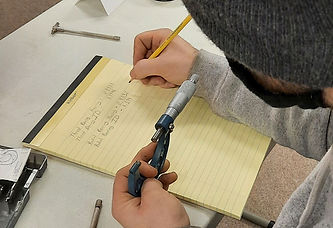
Student using a telescope gauge to transfer precision measurements:
.jpg)
Student beginning shaft straightness test against known tolerances:

Student using a french curve to develop a pump performance curve:
