
Vibration Measurement, Vibration Analysis and PdM Condition Monitoring
Mechanical
Course Number: VMA-504
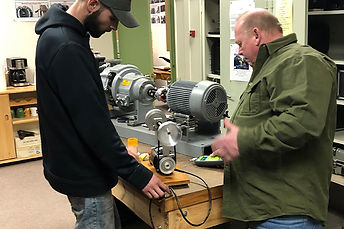
Course Description:
Learning vibration theory of displacement, velocity and acceleration and the application of vibration measurement techniques to isolate machinery faults. Frequency analysis of common problems and how to diagnose them is part of the syllabus. The course covers bearing failure trending using acoustical emission and the use of oil analysis for determining internal failures in gearboxes and agitators.
Each student will receive class books, work activity sheets, self-test progress evaluations, as well as questions from the instructor to make sure they understand the material presented. It is expected that an attendee will leave the class with the basic knowledge of the subject and possess new found skills to better equip them when they return to their job. A certificate suitable for framing will be issued to each attendee who successfully completes the course.
Hands-on activities:
60% hands-on activities
Class Supplies:
Vibration instruments are supplied to use in class but attendees are allowed to bring their own instruments to learn to use them on our test equipment.
4-day course: $1895 per person
Course Syllabus
I. BASICS OF VIBRATION
-
What is vibration — What causes vibration
-
Characteristics of vibration
-
Frequency — Displacement — Velocity —
-
Acceleration — Phase — Acoustical emission
-
Other Characteristics
-
Forced vibration, Free vibration, Natural frequency, Resonant frequency, Critical speed
-
Measurement units
-
Peak-to-peak — in/sec peak — RMS
-
Conversion of vibration measurements
-
Significance of vibration characteristics
-
Information provided by vibration frequency
-
Information provided by vibration amplitude
-
When to use velocity measurement
-
When to use displacement measurement
-
When to use acceleration measurement
-
Information provided by phase
-
Assessing vibration severity
-
How much vibration is too much
-
General vibration severity chart
-
Acoustical emission bearing failure chart
II. VIBRATION MEASUREMENT
-
Seismic velocity pickups (moving coil)
-
Theory of operation — Characteristics —
-
Magnetic interference
-
Accelerometers
-
Non-contact (Proximity) transducers
-
Theory of operation — Installation
-
Mounting of transducers
-
Seismic velocity pickups and accelerometers
-
Stud mounted — Epoxy mounted — Handheld without a probe — Hand-held with a probe — Magnetic holder — Vice-grip pliers — Shaft stick
-
Guidelines for transducer selection
-
Selecting transducers
-
Mechanical characteristic of the machine
-
Considering measurement parameters
-
Measurement parameters
-
Frequency range
III. DATA ACQUISITION
-
What is vibration analysis
-
Machine design and operating characteristics
-
Machine characteristics
-
Purpose of measurement
-
Selection of measurement parameters
-
Measurement positions and directions
-
Selection of vibration measurement instruments
-
Vibration meters – features
-
Vibration analyzers – features
-
Selection of measurement transducers
-
Determination of data required
-
Taking measurements
-
Things to consider
-
Common types of measurements
-
Taking waveform measurements
-
Use of filtering
-
Long and short time samples
-
Measuring frequency
-
Setting up a PdM program that works
IV. DATA INTERPRETATION
-
General analysis procedures
-
Diagnosing machinery vibration
-
Vibration due to unbalance
-
Vibration due to misalignment
-
Vibration due to eccentricity
-
Vibration due to faulty anti-friction bearings
-
Vibration due to faulty sleeve bearings (plain bearings)
-
Vibration due to mechanical looseness
-
Vibration due to drive belts
-
Vibration due to gear problems
-
Vibration due to electrical faults
-
Vibration due to resonance
-
Vibration due to aerodynamic and hydraulic forces
-
Vibration due to reciprocating forces
-
Vibration due to rubbing
-
Beat vibration
-
Use of strobe light and phase for diagnosis
-
Background vibration
Course Pictures
Classroom Testing:

Use in a Confined Space:

Acquiring Vibration Data:
